
Last updated October 16, 2026
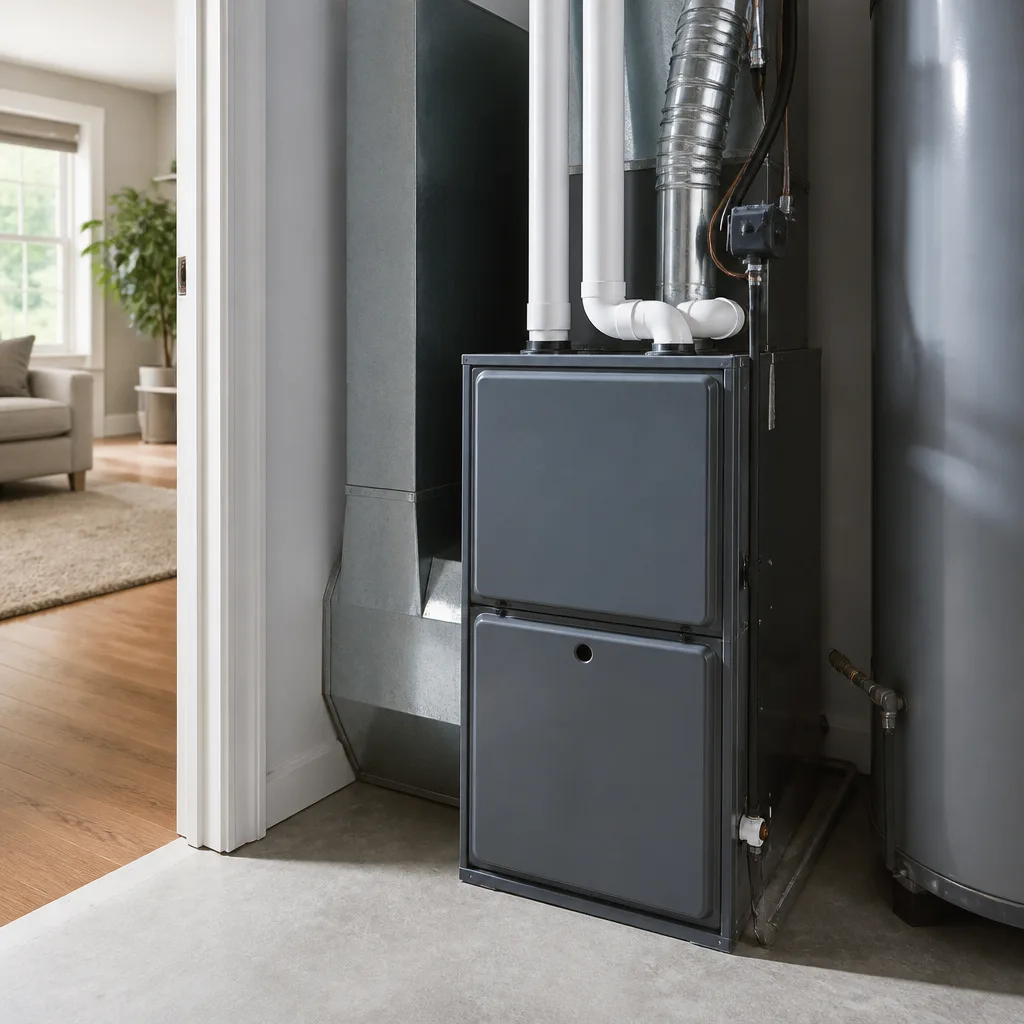 Furnace & heating
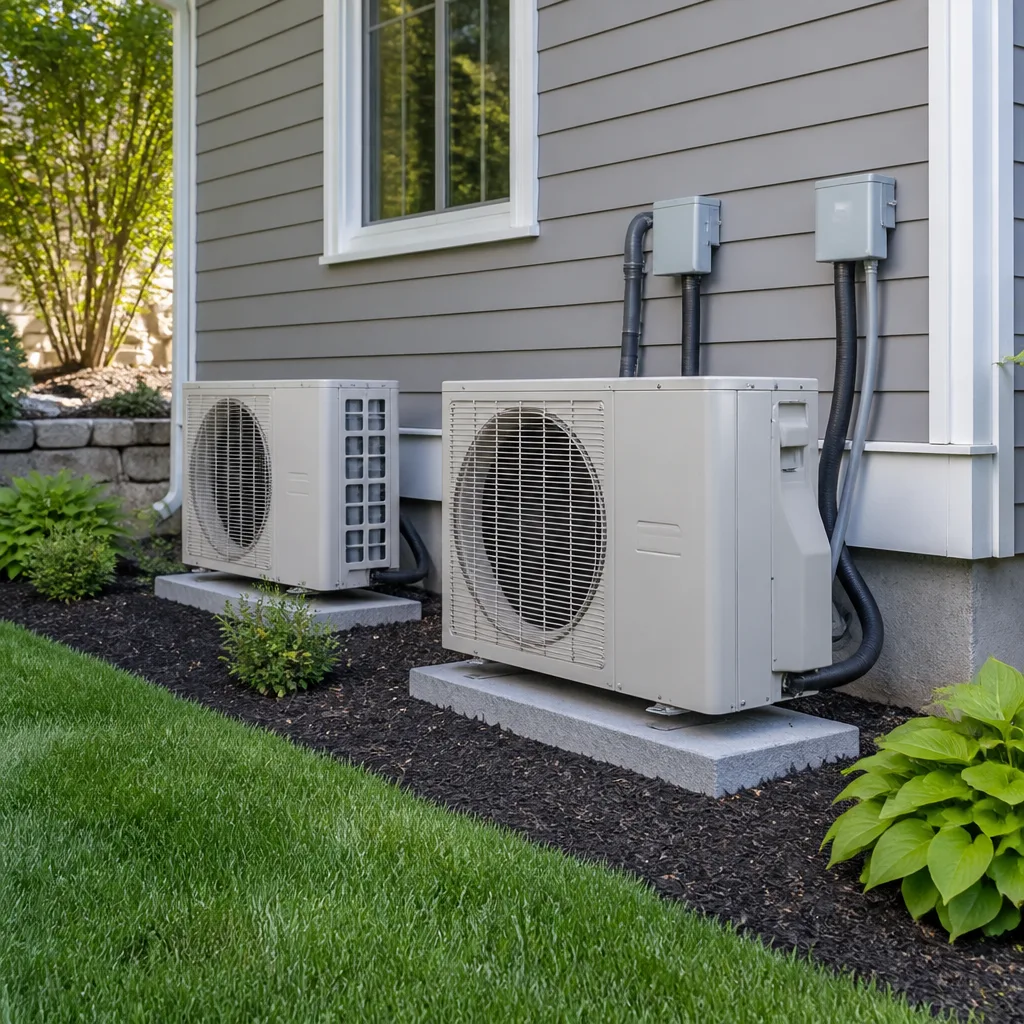 Heat pumps
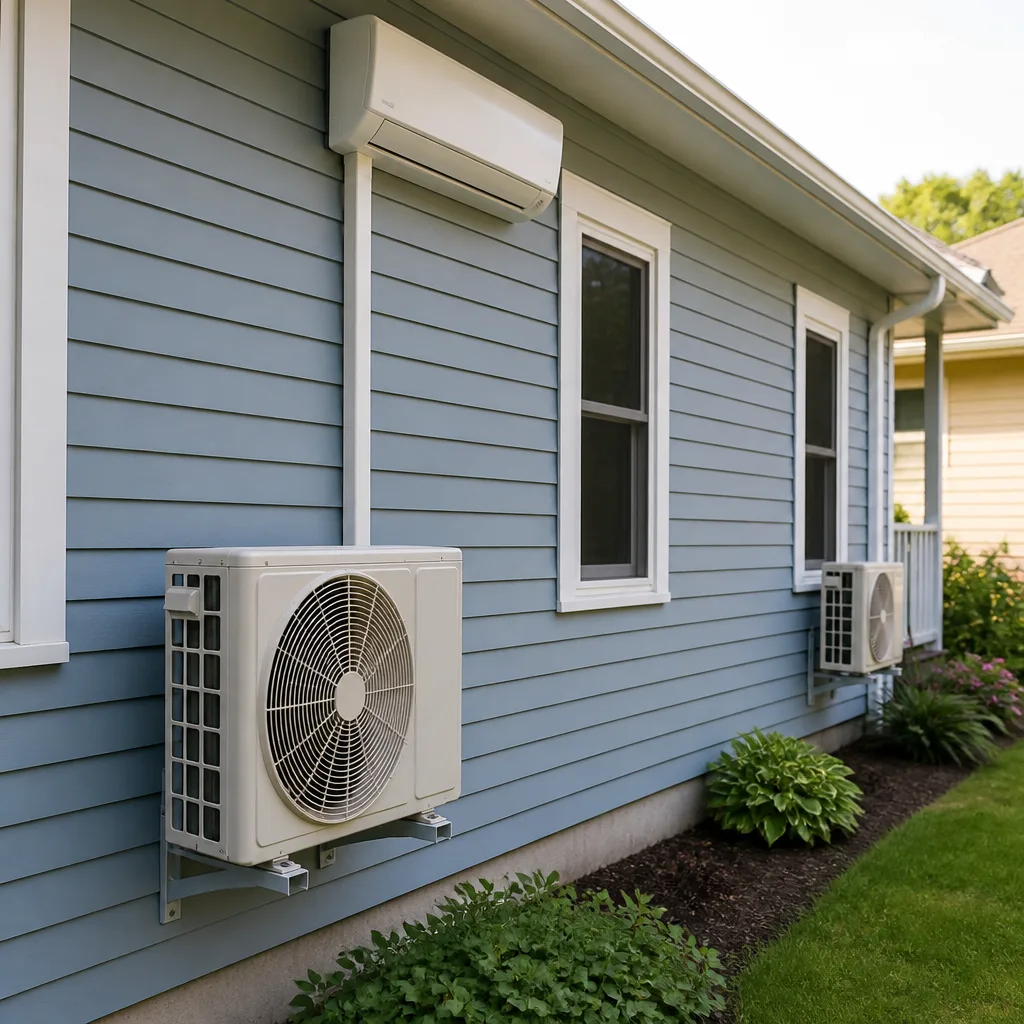 Ductless mini splits
 Carrier
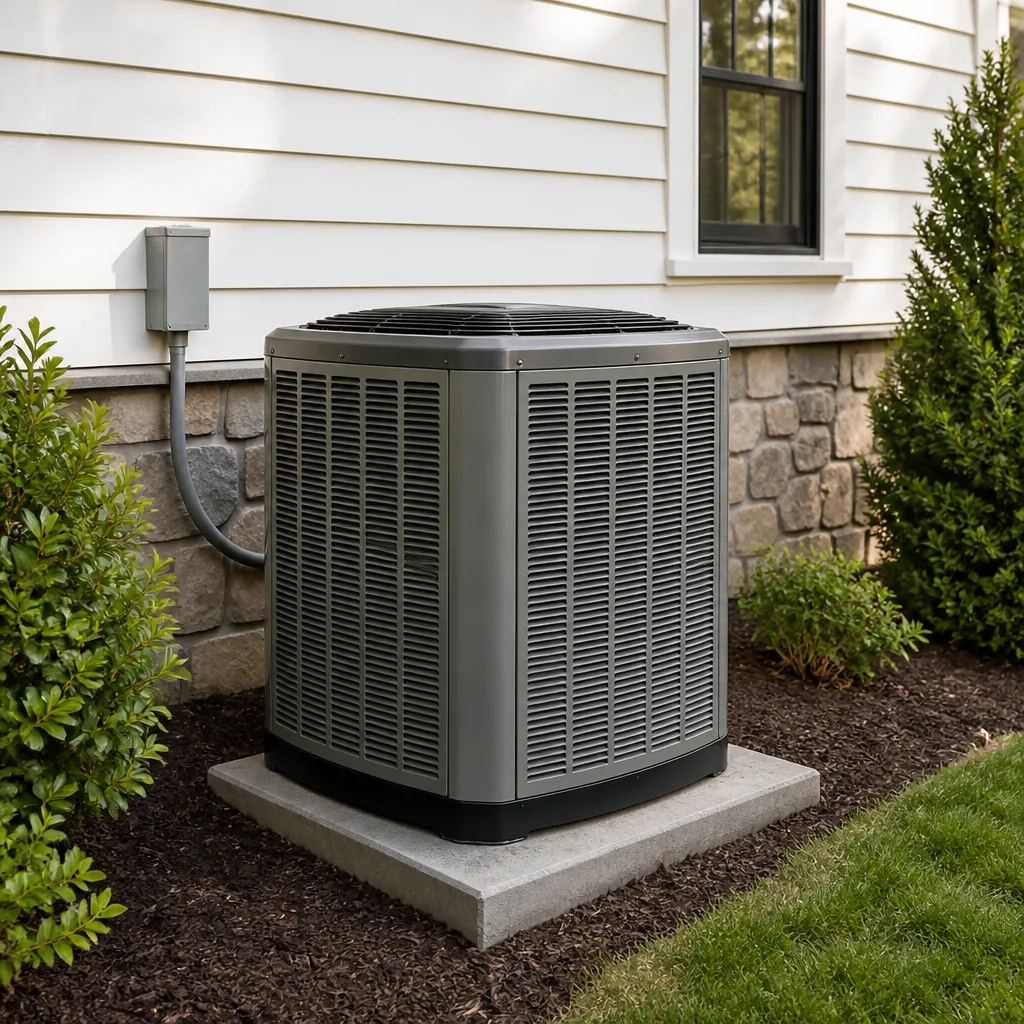 Trane
TraneSeasonal tune-up and full diagnostic on your Carrier, Trane, or Goodman system - readings shown to you before any repair is proposed
Diagnosis first, numbers second - you approve the repair price before a single part goes in.
Get your free estimateAC Repair Maintenance Checklist for Woodland Hills Homeowners
The #1 reason Woodland Hills ACs fail mid-heatwave isn’t a broken compressor – it’s a $4 air filter that was last changed in October. We know because we get the call every July: the unit is running, the thermostat says 78, but the air coming out of the vents feels like a warm sigh. This guide gives you a maintenance checklist written for the person standing in their backyard at 7 p.m. on a 102-degree day, wondering why the condenser sounds like a garbage disposal. For more guides & resources, explore our blog. You’ll learn what to check monthly, what to leave alone, and how to document everything so a warranty claim never gets denied. No contractor jargon without a plain-English translation. No vague “inspect the system” bullet points. Just pass/fail tests you can actually perform.
Quick Answer
The core AC maintenance checklist for Woodland Hills homeowners breaks into five repeatable tasks: change or clean your air filter every 30-60 days (more often during wildfire season), clear at least two feet of debris around the outdoor condenser, check that the thermostat is reading accurately, inspect visible ductwork in the attic for gaps or compression, and document every task with photos and dates in a simple maintenance log. Do those five things consistently and you’ll prevent roughly 70% of the AC failures we see in Woodland Hills before they happen.
Styles & brands we work with
Table of Contents
- The Monthly Maintenance Checklist: Five Pass/Fail Tests
- The Woodland Hills Seasonal Calendar: Month by Month
- The 5-Minute Visual Inspection Before You Call a Tech
- Filter Selection: MERV Ratings and Wildfire Smoke
- How to Document Maintenance for Warranties and Home Inspectors
- Three Maintenance Tasks That Void Warranties When Done Wrong
- Common Mistakes to Avoid
- When to Call a Professional
- Frequently Asked Questions
The Monthly Maintenance Checklist: Five Pass/Fail Tests
Most maintenance guides read like a contractor’s job sheet, full of “verify compressor amperage” and “check superheat and subcooling.” You don’t need to know what superheat means to keep your system healthy. What you need is a simple test for each component: here’s what good looks like, here’s what bad looks like, here’s what to do next. In our experience serving homeowners across Woodland Hills, the five checks below catch more real problems than any $200 maintenance plan.
Test 1: The Filter Pull Test. Slide out your filter and hold it up to a light. If you can see light through it, it’s still passing air. If it looks like a gray felt blanket, it’s done. That’s the entire test. Change it, don’t debate it. A clogged filter forces the blower motor to work harder, raises energy use by up to 15%, and can freeze the indoor coil. In Woodland Hills, where our AC runs from May through October, a 1-inch filter done July 1 was likely installed in June and already needs attention. Filters are the single highest-leverage maintenance item in this entire guide.
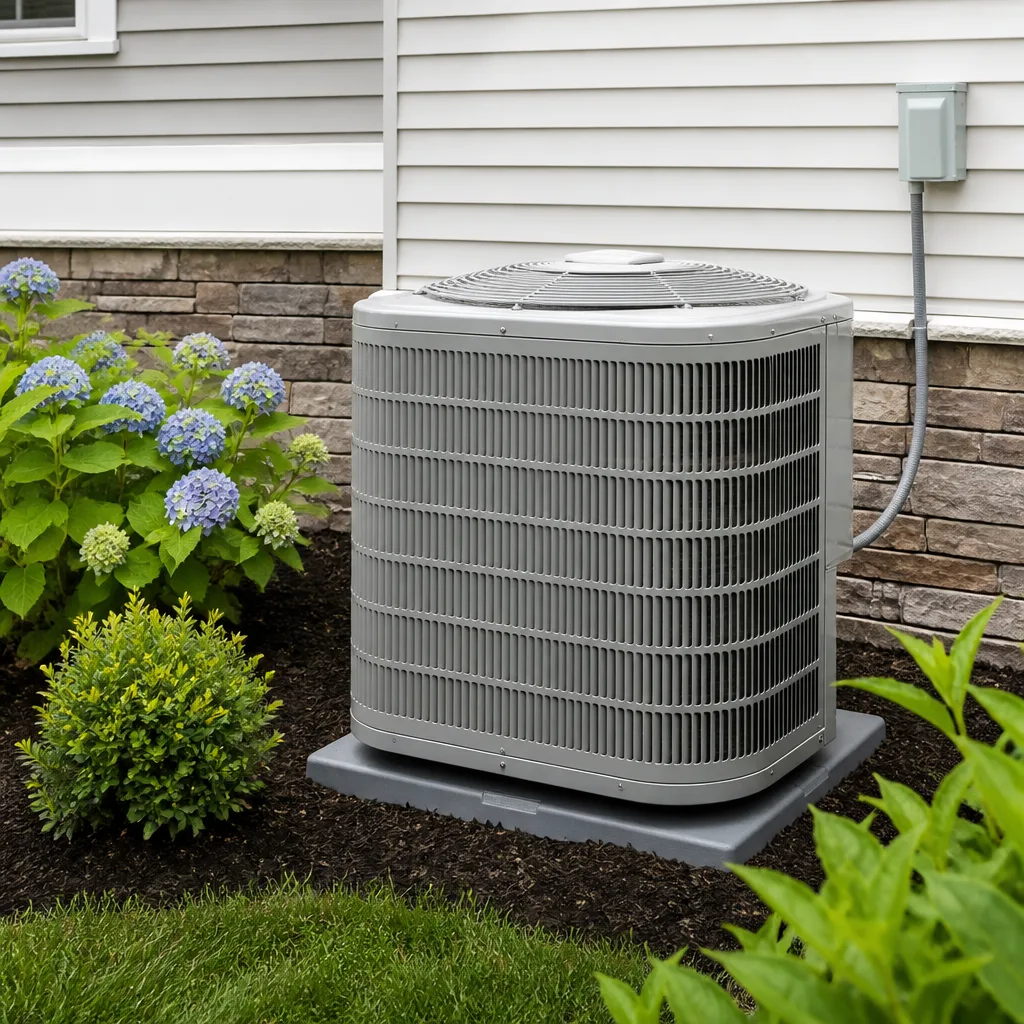
Test 2: The Two-Foot Clearance Test. Walk outside to your condenser (the big metal box with the fan). Put your foot against the unit’s side and walk a two-foot circle around all four sides. Everything inside that circle should be air and maybe a concrete pad. No bushes, no stored patio furniture, no that stack of firewood you’ve been meaning to move. Plants over 18 inches tall will want to lean in. Cut them back. The condenser pulls air in through the sides and exhausts it out the top; when the sides are blocked, it can’t shed the heat it’s removing from your house. In Woodland Hills, bougainvillea and jasmine grow fast from March through May. Trim them before they reach the unit, not after.
Test 3: The Thermostat Honesty Test. Set the thermostat 3 degrees below whatever the room currently reads. Walk to a vent and hold your hand in front of it for 60 seconds. You should feel air moving and it should feel noticeably cooler than the room air, not just “a little cool.” If the air feels weak or only mildly cool, either the filter is clogged, the coil is dirty, or the refrigerant charge is low. That last one is a pro job, not a YouTube fix. Also check that the thermostat isn’t sitting in direct afternoon sun from a west-facing window, which fools the sensor into running the AC longer than needed. This is a real issue in Woodland Hills homes where the living room thermostat faces the San Fernando Valley afternoon heat.
Test 4: The Drain Line Water Test. While the AC is running, find the white PVC pipe that comes off the indoor unit and heads either to a floor drain or outside. There should be a slow drip or trickle when the system runs in humid conditions. If it’s bone dry on a muggy August day in Woodland Hills, the drain line may be clogged. A clogged drain line is the #1 cause of water damage around AC units, and it’s fully preventable. Pour one cup of white vinegar down the drain line at the beginning of each cooling season to break up algae and mineral buildup. That’s a $3 maintenance task that prevents a $900 drywall repair.
Test 5: The Sound Test. Stand next to your indoor unit while it runs. You should hear a smooth, low hum – the fan moving and the compressor humming quietly somewhere nearby. You should not hear rattling, squealing, banging, or a sound like someone shaking a can of bolts. Any of those sounds means a specific thing: a loose panel, a failing blower motor bearing, or a component vibrating against the cabinet. Record a 10-second phone video of the sound and send it to a tech before they roll out. It helps them bring the right part on the first visit, which saves you a second trip. We love it when Woodland Hills homeowners send us a sound video; it makes diagnostics faster and keeps labor costs down.
The Woodland Hills Seasonal Calendar: Month by Month
Generic maintenance schedules say things like “check in spring” and “check in fall.” That’s nice advice for Cleveland. Woodland Hills has a different rhythm. Our heat arrives early, hangs around through October, and we get Santa Ana winds that dump dust and debris into outdoor units starting in September. Here’s the calendar we actually follow when working with homeowners in Woodland Hills, Canoga Park, and Calabasas. If you’re new to the area, start with The Complete Guide to HVAC in Woodland Hills.
January and February: Your AC is mostly resting, but the furnace is working. Use this window to do exactly one thing for the AC: schedule a pre-season check. You’ll beat the March rush, which is when everyone in Woodland Hills suddenly remembers summer is coming. A pre-season check should include coil cleaning, refrigerant pressure verification, and a capacitor test. Capacitors fail predictably after 7-10 years, and fail more often in heat. Catch a weak capacitor in February and you replace a $250 part on your schedule. Miss it and you replace the same $250 part at 6 p.m. on a 104-degree Saturday in July, plus emergency dispatch. Same part, different price tag.
March and April: This is your deep-clean window. Clean the condenser coils with a garden hose (gentle spray, not a pressure washer – pressure washers bend the coil fins and reduce airflow permanently). Clear the area around the outdoor unit down to bare dirt if needed. Check all accessible supply registers inside the house and make sure furniture hasn’t been pushed over them. In Woodland Hills, this is also when jasmine starts its spring growth surge. Cut it back now, not when it’s already wrapped around the condenser.
May: Here’s the one competitors miss. Woodland Hills does not get a gentle spring. May temps regularly hit the high 80s, and the first real heat wave often lands before Memorial Day. If you wait until June to “get the AC checked,” you’re already behind. In May, run the AC for a 30-minute test cycle, check the drain line drip, confirm the thermostat is reading correctly, and change the filter one more time. Open every register fully. You want the system to hit the first heat event already tested, not discovering in real time that the capacitor from 2017 didn’t survive winter.
June through September: Peak load. Change the filter every 30 days, period. When wildfire smoke settles into the Valley, it clogs filters faster than anything else, and a clogged filter in August is a frozen coil waiting to happen. Check the outdoor unit weekly for debris after any wind event, which in Woodland Hills means after every Santa Ana. Listen for new sounds. If the system starts short-cycling (turning on and off every 5-10 minutes instead of running 15-20 minute cycles with pauses in between), call a tech. Short-cycling burns electricity and kills compressors faster than any other failure mode we see.
October and November: The hard season transition. Santa Ana winds in October and November blast dust, leaves, and whatever else is airborne straight into outdoor condenser coils. This is when you do a final outdoor clean: hose off the coils, clear the debris, trim back anything that grew over summer. You should also schedule your heating check in late October or early November, because the furnace hasn’t run since March and it may have issues. In Woodland Hills, many homes have combined HVAC systems where the AC and furnace share the same blower and ductwork. A furnace problem discovered in December is a much bigger headache than one discovered in October.
December: The AC can rest. Change the filter on schedule anyway, because the furnace is pulling the same air through the same ductwork. The dust doesn’t know which season it is.
The 5-Minute Visual Inspection Before You Call a Tech
Before you call for our AC Repair services in Woodland Hills, do a 5-minute walkthrough. You’ll either solve the problem yourself or give the tech enough information to bring the right part on the first visit. Here’s the exact sequence we walk our customers through.
Step 1: Check the obvious power points. Confirm the thermostat has fresh batteries and is set to “cool.” Check the electrical panel (breaker box) and look for a tripped breaker. In Woodland Hills, many homes built in the 1960s and 1970s have original electrical panels; breakers trip during heat waves when the grid is stressed. Reset once. If it trips again, that’s not a nuisance trip – that’s a short or overload, and it needs a pro.
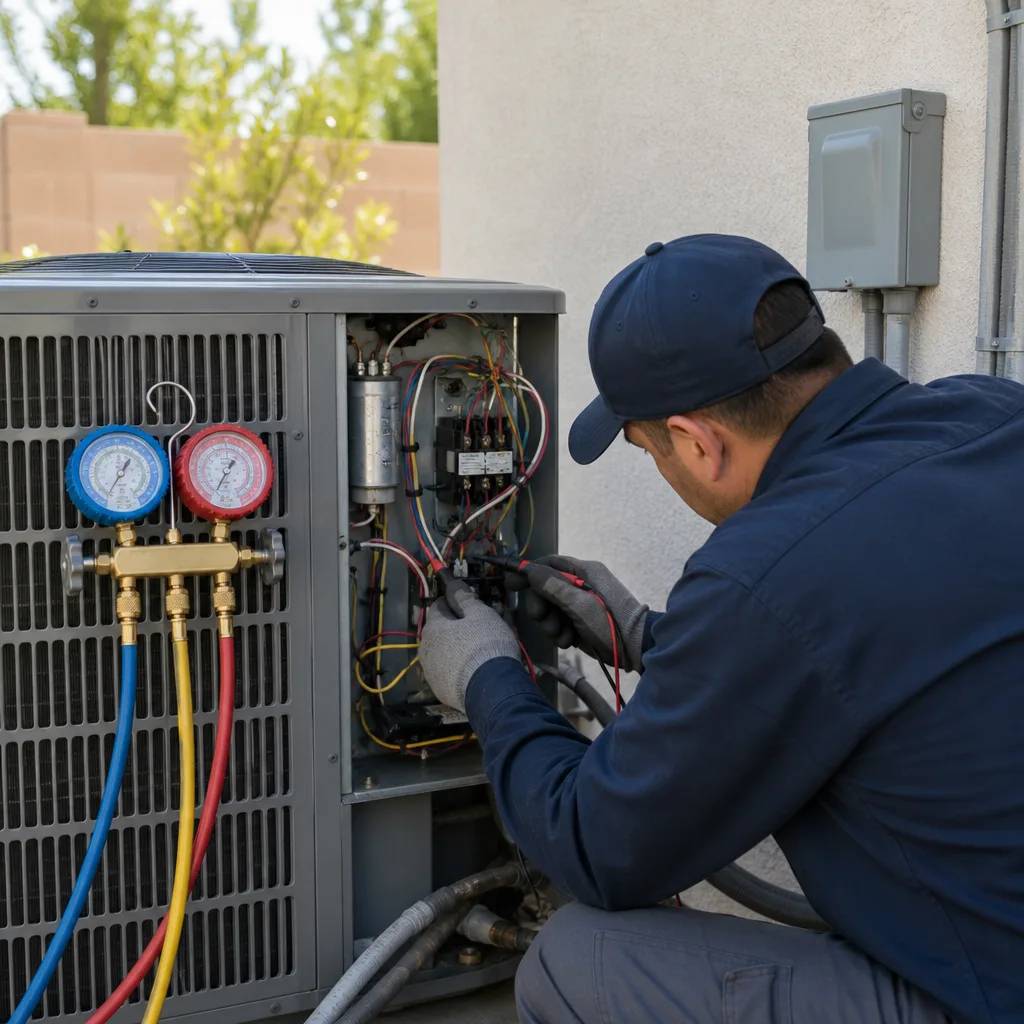
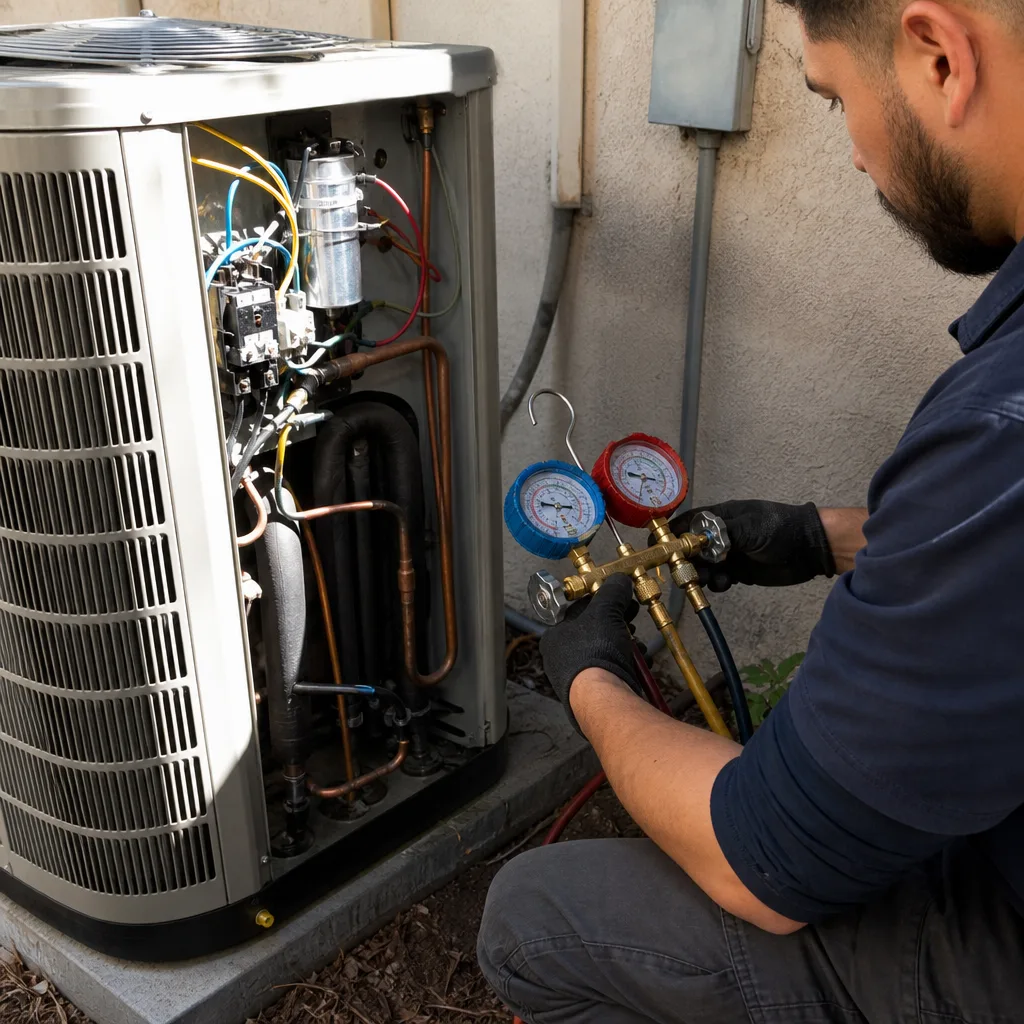
Step 2: Look at the refrigerant lines. The two copper lines running from the outdoor unit to the house should be insulated where they leave the condenser. The small line (liquid line) should be warm to the touch. The large insulated line (suction line) should be cool and sweaty, not frozen. If you see ice or frost on that large line, turn the AC off immediately and switch the fan to “on” to thaw the coil. Here’s the truth YouTube gets wrong: frost on the line does NOT always mean low refrigerant. It means low airflow (usually a clogged filter or dirty coil) or low refrigerant. If you just changed the filter and the frost came back within 24 hours, you probably do have a refrigerant issue – and that’s a sealed-system job for a licensed tech, not anything you can fix with a $40 can from the auto parts store. Those “recharge kits” are bad news for your compressor.
Step 3: Inspect the outdoor coil surface. Shine a flashlight through the side of the condenser. You should see a clean, silver grid of fins. If the fins look like gray velvet, that’s a dirt-packed coil that’s killing your efficiency. If you see any dented or flattened sections – usually from a weed whacker, a dog, or a kid’s soccer ball – that’s reduced airflow. Bent fins can be combed straight with a $12 fin comb, but deep denting indicates possible coil damage, which is a leak waiting to happen.
Step 4: Check the drain pan. If your indoor unit has a visible drain pan underneath, look for standing water. A little condensation is fine. A puddle that never drains means the line is clogged and water is about to back up into the unit or the ceiling below. This is a simple fix for a pro with a wet/dry vac and a drain snake, but left alone it causes serious water damage. In Woodland Hills, where we sometimes get those muggy late-summer weeks, this is one of the most common avoidable failures we see.
Step 5: Look for unusual wear around the unit. Oil stains on the concrete pad under the condenser, rust on the cabinet seams, or a refrigerant line that’s shiny at one connection and oily at another all point to specific faults. Oil at a line connection is a refrigerant leak indicator. Rust at the coil U-bends means the coil is aging out. Take a photo. Send it to your tech before they dispatch. We can often diagnose the likely failure from a good photo and show up with parts in hand.
Filter Selection: MERV Ratings and Wildfire Smoke
The filter aisle at Home Depot is a wall of confusion: MERV 5, MERV 8, MERV 11, MERV 13, electrostatic, washable, 3M Filtrete at $22 a pop. Here’s the plain-English guidance we give to Woodland Hills homeowners, informed by our local air quality reality.
MERV, explained in one sentence: MERV is a rating from 1 to 16 that measures how many small particles a filter catches; higher MERV catches more stuff but makes the blower work harder. That tradeoff is everything.
For most Woodland Hills homes, MERV 8 is the sweet spot. It catches the dust, pet hair, and pollen that actually affect system health without choking airflow. A MERV 8 1-inch filter costs around $8-$12 and should be changed every 30-60 days depending on season and pets. If you have a modern system with a 4-inch or 5-inch media cabinet filter, you can run MERV 11 and change every 6-12 months. Media cabinets are becoming common in newer Woodland Hills homes and they’re great, but only if you remember the filter even exists. We see so many media filters that have been in place for 3 years. The static pressure build-up is brutal on blower motors.
Wildfire smoke changes the math. When smoke settles into the San Fernando Valley – and it does, every fire season now – even a MERV 8 filter will load up in 2-3 weeks. During active smoke events in Woodland Hills, check your filter every 14 days. If you want to run MERV 11 or 13 during fire season for indoor air quality, that’s a reasonable tradeoff, but only on systems with a 4-inch or 5-inch filter cabinet, or on variable-speed blowers that can push against the added resistance. A standard 1-inch filter slot on an older single-speed blower shouldn’t run anything higher than MERV 8 without risking airflow problems. We have seen MERV 13 filters in 1-inch slots freeze coils during the first heat wave of the year, because the added resistance pushed subcooling off a cliff. Your AC is a heat mover before it’s an air purifier. Respect that order.
Do not buy “electrostatic washable” filters. They promise savings and deliver restriction. The attraction works for about three months, then the static charge fades and they become a dense mesh that blocks airflow. We see them everywhere in Woodland Hills because they’re marketed well, and we replace them everywhere for the same reason: premature blower motor failure. A good disposable filter is cheaper than a blower motor, which runs $800-$1,400 installed depending on the system.
How to Document Maintenance for Warranties and Home Inspectors
Here’s a scenario we’ve seen play out in Woodland Hills more than once: a homeowner has a compressor fail under a 10-year manufacturer warranty, files a claim, and gets denied because they couldn’t prove the system was maintained. Carrier, Bryant, Trane, American Standard – all the majors have the same basic clause: the warranty covers defects in materials and workmanship, provided the system received regular maintenance. No documentation of maintenance means no warranty, full stop. It doesn’t matter if you changed the filter every month. If you can’t show it, you didn’t do it.
Here’s the documentation system we recommend, and it takes about 3 minutes per month:
- Use a simple Notes app folder or Google Keep, not a filing cabinet. Create a note called “HVAC Log” and keep it pinned. Every maintenance action gets one line and one photo.
- Log every filter change with a photo of the old filter next to the new filter, and the date. That photo proves you changed it, and the difference between the two filters tells a story about your air quality.
- Log every professional service visit. Scan or photograph the invoice. Write the date, the tech’s name, what was done, and what parts were installed. If the tech gives you a written report (we always leave one), photograph it and put it in the note.
- Log every repair with before-and-after photos. If a capacitor was replaced in June, that’s five photos and a two-sentence entry. In a warranty dispute three years later, that entry is the difference between a free compressor and a $3,500 bill.
- Once a year, export or screenshot the whole log and save it to cloud storage. Phones get lost. Notes apps get wiped. A home inspector or warranty claim reviewer wants to see a continuous history, not a “I swear I maintained it” story.
For home inspectors and resale: A documented maintenance history adds real value when you sell a Woodland Hills home. When a home inspector sees a clean, organized maintenance log, they report “HVAC appears well-maintained” and the buyer’s anxiety drops. When they see a 2012 unit with no history and a dirty filter, they flag it as “HVAC near end of life, budget for replacement.” That flag costs the seller real money at negotiation. Ten minutes of documentation per month is the cheapest home insurance you’ll ever buy.
Three Maintenance Tasks That Void Warranties When Done Wrong
There’s a difference between maintaining your system and working on it. Crossing that line incorrectly is expensive, and we see it happen often enough in Woodland Hills that it needs its own section. Not sure where your skill level lands? Read DIY vs Professional HVAC: The Woodland Hills Homeowner’s Decision Guide. The following three tasks should never be done by anyone other than a licensed HVAC technician. If they’re done wrong and the system fails later, the manufacturer will void the warranty. Not “might” – will.
1. Adding Refrigerant Without a License. Refrigerant is not like washer fluid. It’s a controlled substance, it operates under specific pressure and temperature relationships, and the moment you connect a charging hose to a system you’re legally required to be EPA Section 608 certified. Beyond the legal issue, overcharging a system by even 10% kills compressors. Undercharging by 15% causes refrigerant floodback that kills compressors too. The margin between “right” and “destroyed” is measured in ounces. We’ve seen a homeowner kill a 6-year-old Carrier compressor with a $40 auto-parts-store recharge can, and the warranty was voided the moment the manufacturer’s rep saw the Schrader valve. That mistake cost $4,800.
2. Opening the Sealed Refrigerant System for Any Reason. The refrigerant circuit is sealed at the factory and should stay sealed for the life of the system. If a homeowner or handyman opens it – even to “check for leaks” – and the system later fails, the manufacturer has a strong case that contamination was introduced. Beyond the warranty issue, an open system exposes the compressor to moisture and air, which is a slow poison. This is the kind of job that requires vacuum pumps, micron gauges, and nitrogen purging. Nothing about that sentence is DIY.
3. Replacing Any Component Involving Electrical Wiring or Control Boards. A capacitor replacement seems simple – two wires, a screwdriver, $25 part on Amazon. But capacitors hold a charge, and a simple mistake can damage the control board or start a fire. More importantly for warranty purposes, if a homeowner replaces a capacitor with the wrong spec, and the compressor fails six months later from a hard-start condition, the manufacturer sees a non-licensed modification and denies the claim. We see this especially with Bryant and American Standard systems, where the warranty terms are explicit about who is authorized to replace what. The capacitor is cheap. The compressor it protects is not. Let a pro handle it.
The rule of thumb: if the part requires a screwdriver on the electrical panel, a refrigerant hose, or a vacuum pump, it’s not maintenance. It’s service. Maintenance means filters, debris clearing, drain line vinegar, thermostat settings, and documentation. Everything else gets a professional. That’s not gatekeeping; that’s what your warranty contract says, and it’s what we see prevent expensive failures every week in Woodland Hills.
Common Mistakes to Avoid
- Closing registers in unused rooms. Most people think it saves energy by redirecting air to used spaces. In reality, it increases static pressure, causes the blower to work harder, and can freeze the coil. In Woodland Hills, where systems are already undersized for peak heat days, closing even two registers makes the problem worse. Keep all registers at least 70% open.
- Setting the thermostat to 68 when it’s 105 outside. Your AC can drop indoor temps about 15-20 degrees below outdoor temperature. When it’s 105 in Woodland Hills, 78-80 indoors is the realistic range. Setting the thermostat lower doesn’t make it cool faster; it just makes the system run longer and ice up faster. This is the #1 cause of freeze-ups we see during Valley heat waves.
- Neglecting the drain line until water appears. Pour vinegar down the drain line every spring. It costs $3 and takes 3 minutes. Once water backs up, you’re dealing with drywall, insulation, and possibly mold remediation, and that bill starts around $900.
- Using a pressure washer on the condenser coils. The fins are thin aluminum and bend under pressure-washer force. Once they’re flat, airflow drops and efficiency crashes. Gentle garden-hose spray only, at a downward angle.
- Waiting for the system to break before calling a pro. Maintenance visits cost $120-$250. Emergency repairs cost $350-$800 plus whatever got damaged by the failure. In Woodland Hills, a broken AC during a heat wave is also a health risk, especially for elderly residents and infants. The cheapest repair is the one that never happens.
- Running the AC with a frozen coil because “the cold air feels nice for now.” A frozen coil is not normal and the system is actively damaging itself while it runs. When the ice melts, the water goes somewhere, usually into your ceiling. Turn it off, switch the fan to “on,” and call a tech.
When to Call a Professional
Some problems are maintenance items. Some are repair items. The line between them is when a component has failed, not just gotten dirty. Call a professional if you see frost or ice on the refrigerant lines and a fresh filter doesn’t fix it within 24 hours. Call if the system short-cycles – starts and stops every few minutes – because that’s either an electrical issue or a refrigerant problem, and both get worse daily. Call if the outdoor unit hums but the fan doesn’t spin – that’s often a capacitor, and a quick $250 fix becomes a $900 compressor if you wait. Call if you smell burning or anything electrical near the unit. Call if water is anywhere other than the drain pan. Trust the 5-minute inspection in this guide to tell you what’s a filter problem and what’s a “call someone who does this for a living” problem. We answer calls 24/7 with a live person, and we’ll walk you through the 5-minute inspection over the phone before we ever dispatch a truck. Halden Heating and Air Woodland Hills offers free estimates in Woodland Hills – call (559) 245-8195 and we’ll have a tech at your door with a written price before any work starts.
Frequently Asked Questions
Change 1-inch filters every 30-60 days during cooling season (May through October) and every 60-90 days during winter. If you have pets, or during wildfire smoke events, change every 30 days. A dirty filter is the most common, cheapest, and most preventable cause of AC failures we see in Halden Heating and Air Woodland Hills home service area. Give us a call at (559) 245-8195 if you want help setting up a filter-change schedule that fits your system.
Set your thermostat to 78 degrees when you’re home, and 80-82 when you’re away. Your AC can only cool about 15-20 degrees below outdoor temperature, so when it’s 105 outside, 78-80 indoors is realistic and healthy. Setting it to 68 doesn’t make the system cool faster – it just makes it run longer and increases the chance of freezing. For help with your thermostat settings, contact AC Repair in Woodland Hills.
Yes, you can and should clear debris and hose down the condenser coils gently with a garden hose. Do it every month during cooling season, and more often during Santa Ana wind events when dust and debris build up quickly. Do not use a pressure washer, do not open the electrical panel, and do not try to “clean” anything beyond the exterior coil surface. If the coil is deeply packed with dirt, that’s a professional cleaning job done with the unit powered down and the cabinet open. Learn more at AC Installation in Woodland Hills.
When the system runs but doesn’t cool, the cause is almost always one of three things: a clogged filter starving airflow, a dirty condenser coil that can’t shed heat, or low refrigerant from a slow leak. Check the filter first (30 seconds, $10). Clean the outdoor coil second (15 minutes, garden hose). If neither helps, you’re likely looking at a refrigerant issue, which requires a licensed tech with proper charging equipment. Call (559) 245-8195 and we’ll diagnose it with a written price before any work starts.
Yes. An annual professional check in early spring, before the Woodland Hills heat arrives, catches weak capacitors, slow refrigerant leaks, and plugging drain lines before they become mid-summer failures. The maintenance visit costs $120-$250 and typically pays for itself in avoided emergency calls and extended equipment life. Every system we service gets a written report of what we found and what we recommend, with no pressure. We handle Furnace Repair in Woodland Hills with the same protocol.
Turn the AC off immediately, switch the thermostat fan setting from “auto” to “on” to push warm air across the frozen coil, and let it thaw for 2-4 hours. Change the filter while you wait – a frozen coil is usually caused by low airflow, and a dirty filter is the most common culprit. If the system freezes again within 24 hours of running, call us at (559) 245-8195 because you likely have a refrigerant leak or a restricted coil, and continuing to run the system will damage the compressor.
The Bottom Line
Good AC maintenance in Woodland Hills comes down to five repeatable habits: change the filter monthly during cooling season, keep the outdoor condenser clear of debris, test the thermostat’s accuracy, pour vinegar down the drain line every spring, and document everything in a simple log. Do those five things and the majority of AC failures simply never happen. When something does break, act fast – waiting on a small repair is how a $250 capacitor becomes a $4,800 compressor. We answer live 24/7, and we’ll help you figure out whether your issue is a filter change or a real repair before we ever roll a truck. Call (559) 245-8195 and we’ll send a background-checked tech with a live arrival time and a written price before any work starts. That’s how it should work, and it’s how we do it in Woodland Hills.
Written by Andre Fuller, Owner at Halden Heating and Air Woodland Hills, serving Woodland Hills since 2004.
See the difference
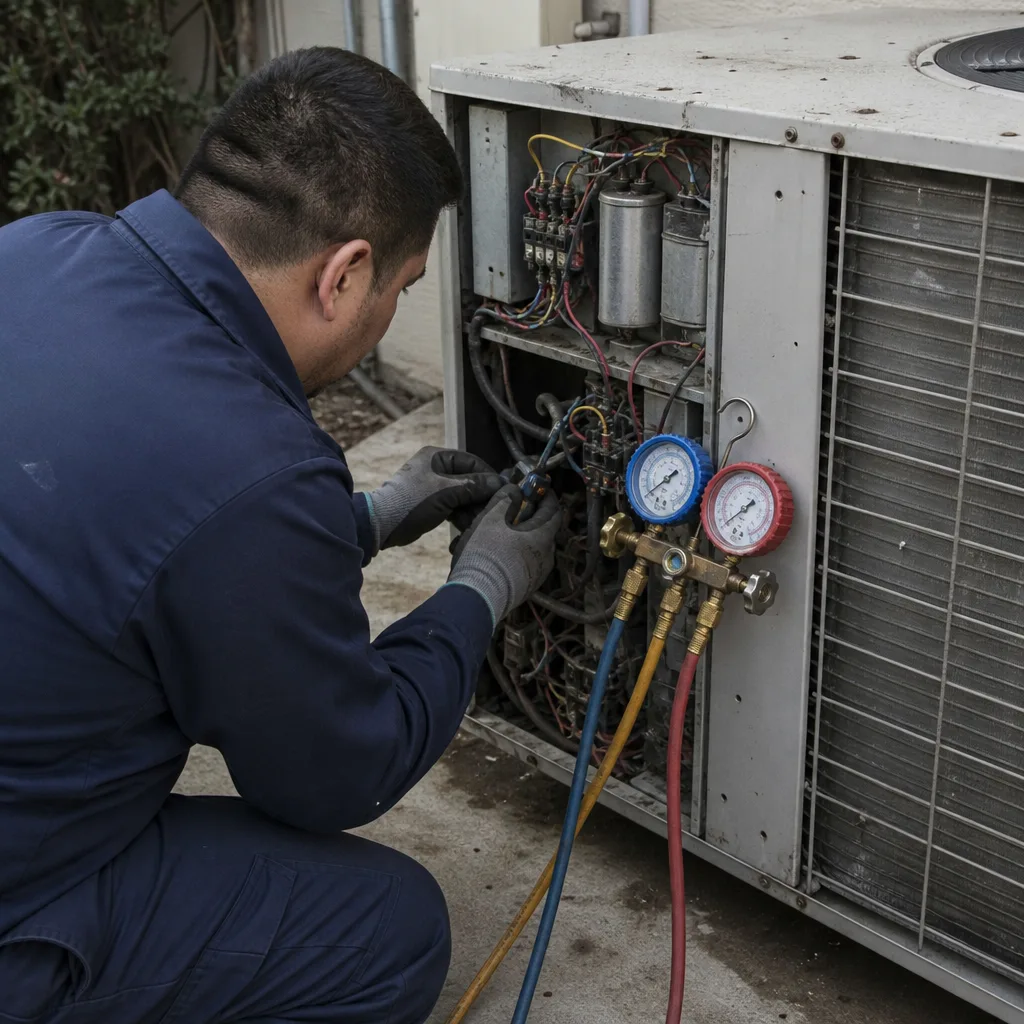 Before
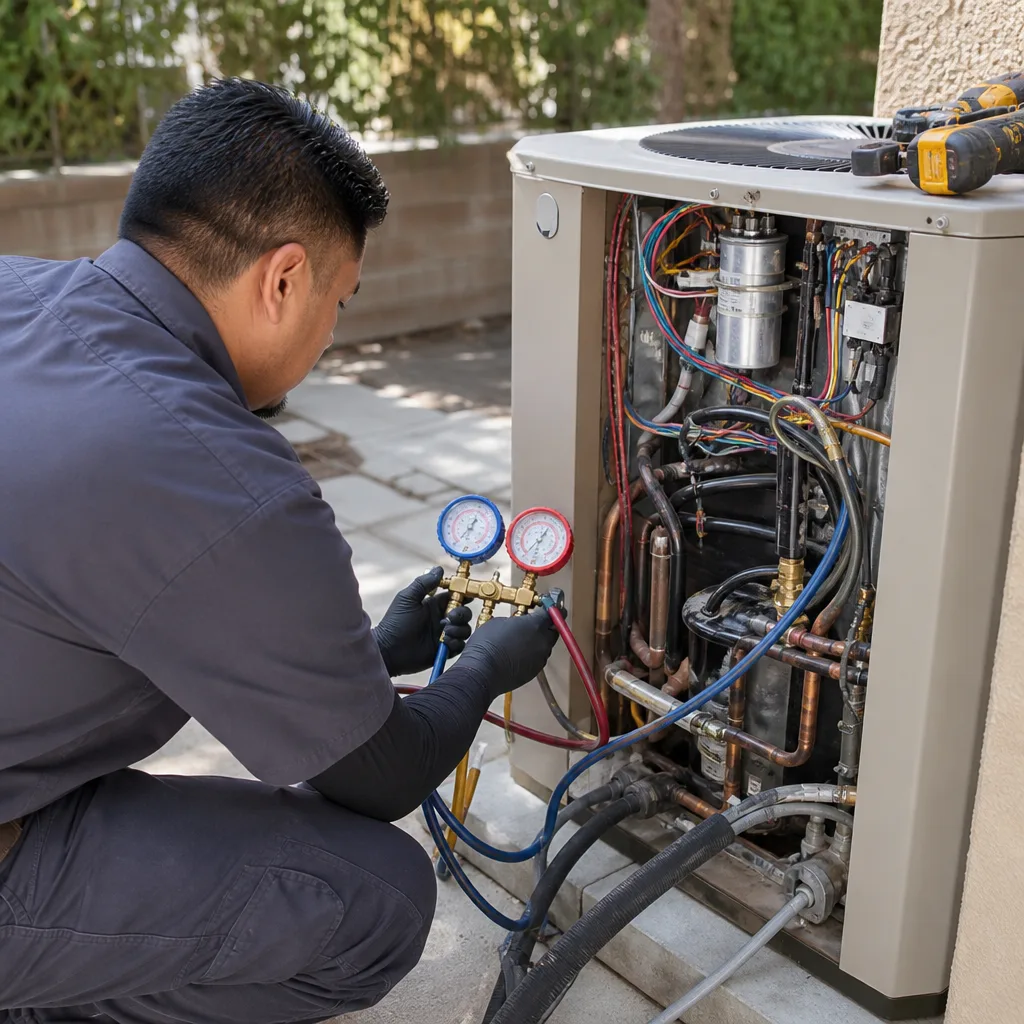 After
After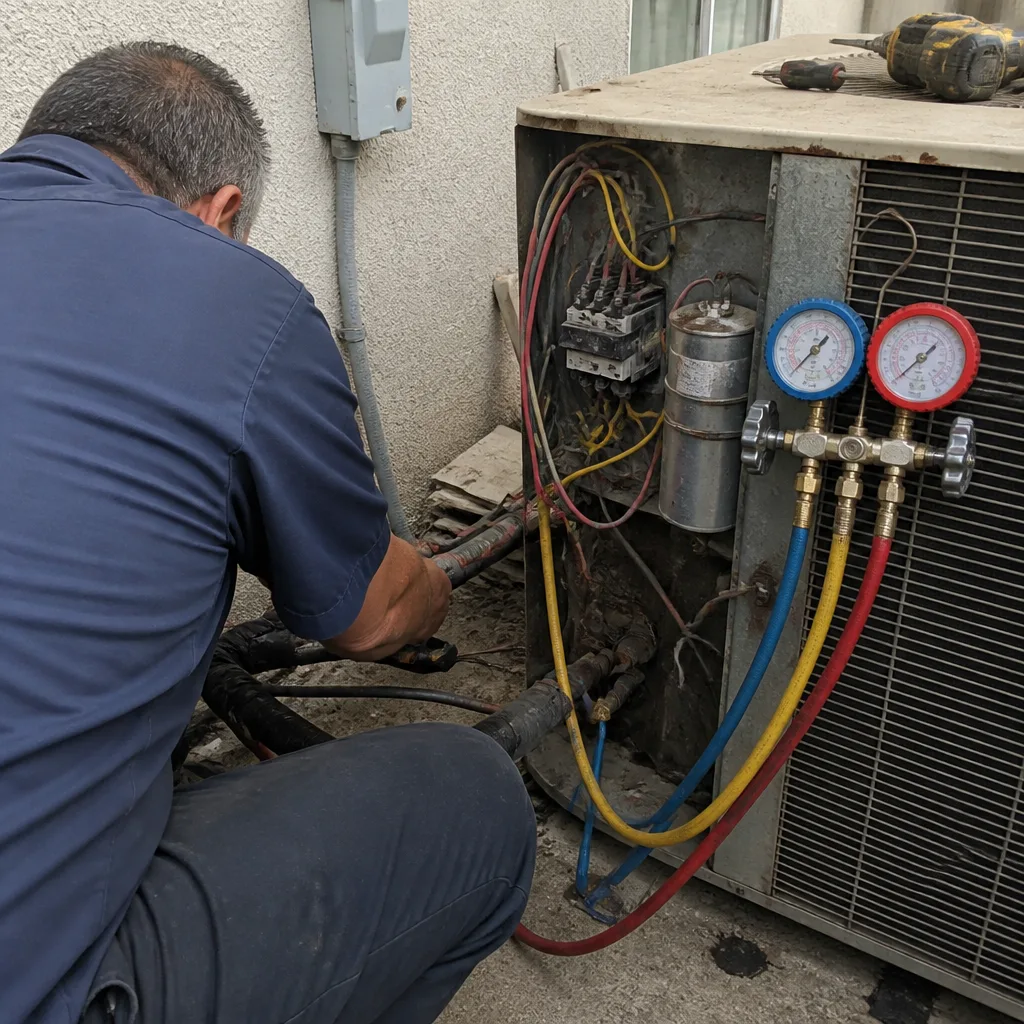 Before
 After
After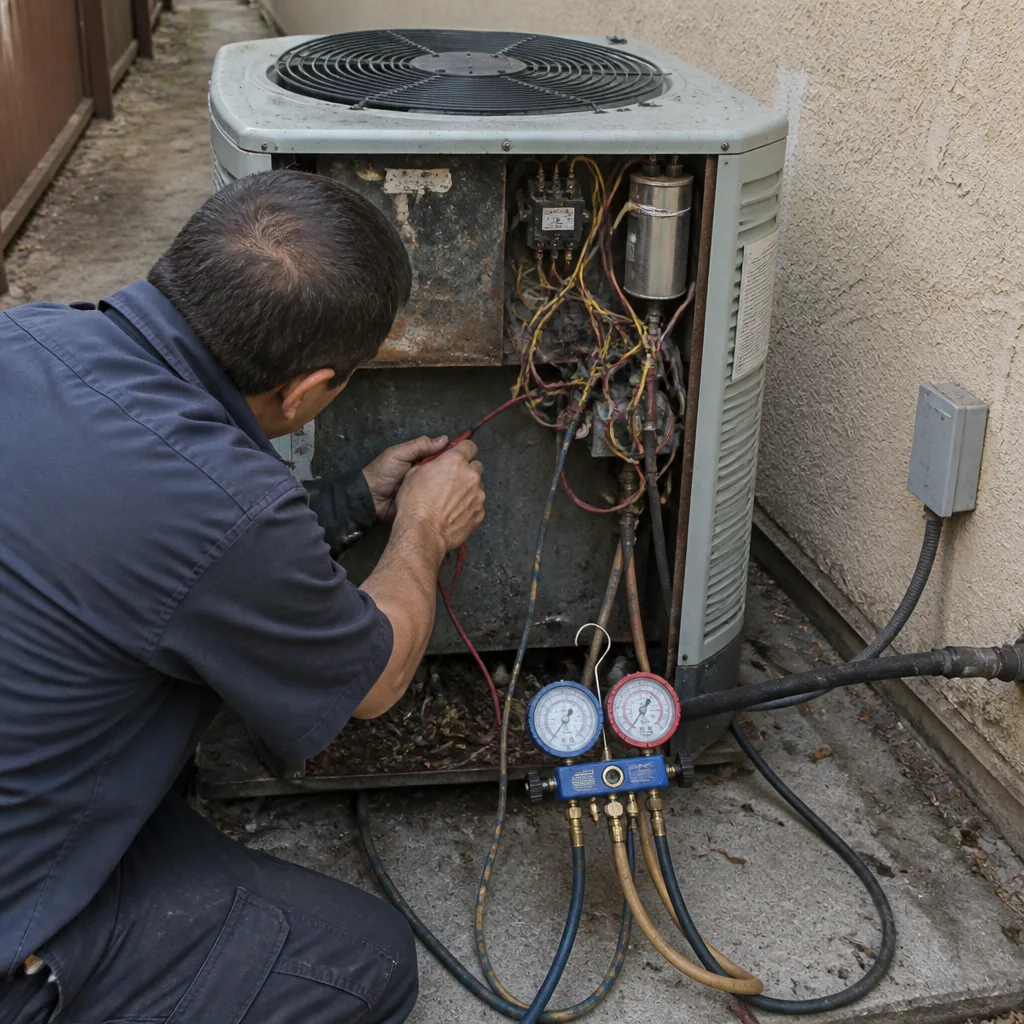 Before
 After
After